
Improving the Prognostic Ozone Parameterization in the NCEP GFS and CFS for Climate Reanalysis and Operational Forecasts
Principal Investigator:
Dr. Gilbert P. Compo, University of Colorado/CIRES and NOAA ESRL, gilbert.p.compo@noaa.gov
Co-Principal Investigators:
Dr. Jeffrey S. Whitaker ,NOAA, Earth System Research Laboratory, jeffrey.s.whitaker@noaa.gov
Dr. Prashant D. Sardeshmukh ,University of Colorado/CIRES and NOAA ESRL, prashant.d.sardeshmukh@noaa.gov
Mr. Craig Long, CPC Principal Investigator, NOAA, National Centers for Environmental Prediction, CPC, craig.long@noaa.gov
Dr. Shrinivas Moorthi, EMC, NOAA, National Centers for Environmental Prediction, shrinivas.moorthi@noaa.gov
Dr. Sarah Lu, EMC Principal Investigator, NOAA, National Centers for Environmental Prediction, EMC, sarah.lu@noaa.gov
Dr. John P. McCormack, NRL Principal Investigator, Naval Research Laboratory, Space Science Division, john.mccormack@nrl.navy.mil
Summary: Make the ozone parameterization in the GFS aware of time-varying atmospheric constituents before and after CFCs and improve the use of additional terms in the parameterization.
Abstract
The objective of this proposal is to improve the representation of stratospheric ozone (O3) and water vapor in NOAA’s climate reanalyses. This work will also improve NOAA’s simulation, analysis, and forecasting of weather and climate variability, including forecasts of UV radiation to protect public health. A complete treatment of O3 photochemistry is too computationally intensive for current models. Therefore, a parameterization is included in the current NCEP Global Forecast System (GFS) atmosphere/land model used in the 20th Century Reanalysis and operational forecasts, and also used in the coupled Climate Forecast System (CFS) Reanalysis and operational CFSv2. The GFS parameterization for the time tendency of O3 is based on parts of NRL’s CHEM2D Ozone Photochemistry Parameterization (CHEM2D-OPP). It includes terms representing net production and loss and a dependency on the ozone mixing ratio itself. It is based on gas-phase chemistry of the late-20th century, which includes the depletion of ozone by chlorofluorocarbons (CFCs). For climate reanalyses and climate modeling extending back to the early 20th century or earlier, before large quantities of CFCs began to be released into the atmosphere, a new version of this parameterization is needed to represent pre-CFC stratospheric O3 chemistry. To understand, analyze, and predict atmospheric variability in the 21st century, the parameterization should utilize additional interactions included in CHEM2D-OPP that affect stratospheric O3. Stratospheric water vapor is also an important radiative constituent. Its representation in the GFS will also be improved, paving the way for improved assimilation of satellite radiances and for interactive chemistry.
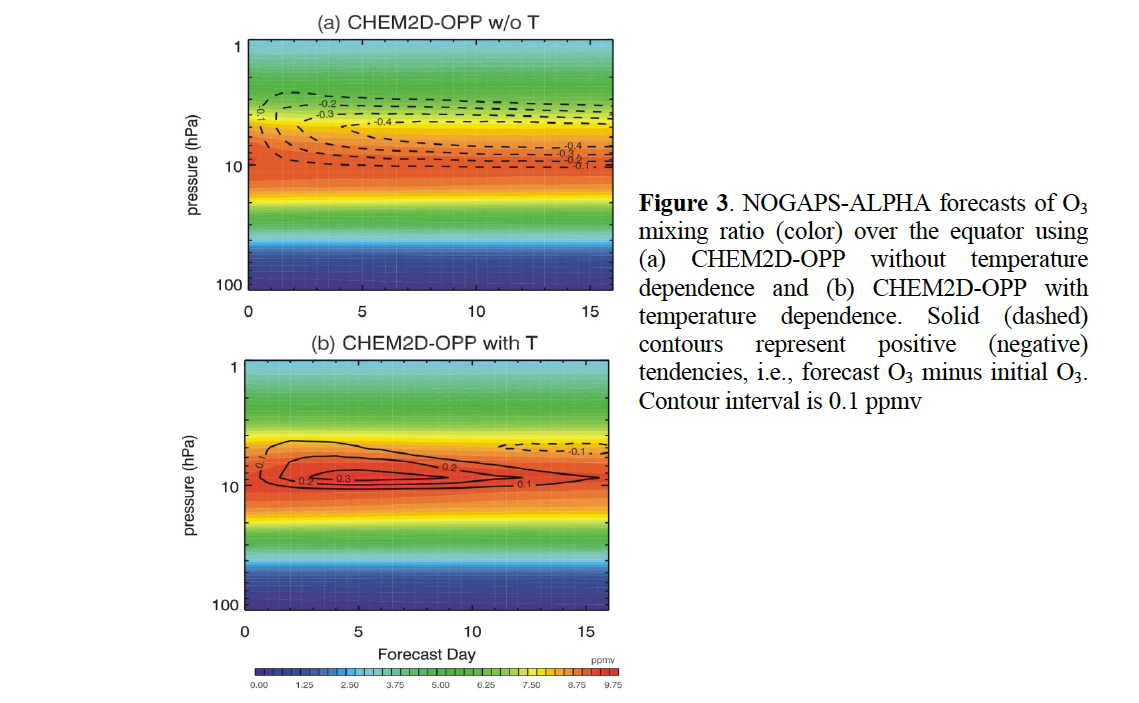
In this proposal, a more advanced O3 parameterization using the full CHEM2D-OPP and an improved treatment of stratospheric water vapor will be implemented for use in new versions of the GFS, CFS, and next generation NOAA climate reanalysis systems. The O3 parameterization will include the effect of changes in temperature, changes in the vertical distribution of O3, and the time-variation of CFCs. As a first step, the parameterization will be tested with two modes, one for times before CFCs and one for times after CFCs began to be released in large quantities. The team will also implement a new stratospheric H2O climatology as a necessary first step toward future implementation of parameterized H2O photochemistry. The upgraded parameterization and new climatology will be tested in climate reanalyses and weather and climate simulations. The impact of the new O3 and water vapor treatments on reanalysis, GFS medium-range forecast skill, and CFS climate simulations will be evaluated using comparisons with both historical and modern O3 and temperature observations throughout the troposphere and stratosphere as well as with UV radiation observations.
Initial progress: Looking carefully at existing parameterization formulation and devising strategy to meet project goals.